

Understanding Devon's Historic Market Towns and Architecture
How Trade Made the Towns
Devon's market towns were not designed for visitors. They grew where trade could actually happen: a bridging point on a river, a crossing of two drovers' routes, a sheltered quay where boats could land. A market charter — many granted in the twelfth and thirteenth centuries — turned a settlement into a town with the right to hold a weekly market and an annual fair. Barnstaple, Tavistock, Totnes, Okehampton, South Molton and Honiton all share that origin story.
The money arrived in waves. Wool, and later serge cloth, built the fine church towers and merchant houses of the fourteenth to seventeenth centuries. Tin from Dartmoor passed through the four stannary towns — Tavistock, Ashburton, Chagford and Plympton — where it was assayed and coined. Fishing, shipping and the Newfoundland trade enriched Bideford, Barnstaple and Dartmouth. Then the railways reached Devon in the 1840s, and towns with a station boomed while others settled quietly into the pattern you see today.
Reading the Street Plan
Once you know what to look for, a Devon town reads like a diagram of its own history. Start in the market square, or the widest stretch of the main street: that is where stalls and livestock were held. Look for the burgage plots — long, narrow strips of land running back from each street frontage, originally rented from the lord of the manor. On a map, or from a back lane, you can still trace them as slim gardens, courtyards and alleys running parallel behind the houses.
Other giveaways include a pannier market or covered market house raised on pillars, a butter walk or corn exchange, almshouses grouped around a quiet courtyard, and a town clock on a civic building rather than a church. Where a town had a quay, the grandest buildings often face the water instead of the square — Bideford, Kingsbridge and Dartmouth are good examples. Narrow service lanes behind the frontages tell you where carts, animals and deliveries were kept out of sight.
What the Buildings Are Made Of
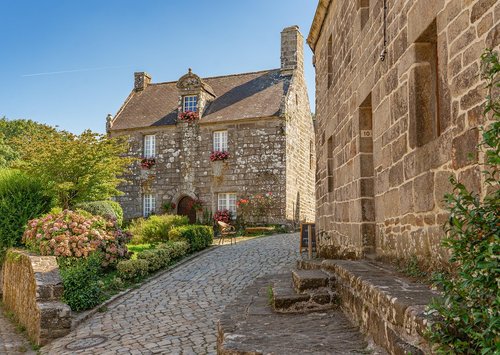
Devon's geology changes roughly every twenty miles, and the buildings change with it. The most distinctive local material is cob: subsoil mixed with straw and water, built up in layers on a stone plinth, then rendered in lime and limewashed. Cob walls are thick, slightly rounded at the base, and their windows sit deep in the wall. You will see them across mid and north Devon, often painted white or cream and topped with thatch or slate.
Elsewhere, look for:
- Red sandstone around Exeter, Tiverton and the Culm valley — warm in colour, crumbling at the edges, frequently patched.
- Chert, flint and limestone in the east of the county, giving Honiton and the Blackdown Hills a greyer, flintier look.
- Granite on the Dartmoor fringe, used for lintels, gateposts and entire walls.
- Hung slate tiles — slates nailed to battens over a timber frame or old cob. This is a Devon speciality and sheds rain beautifully, which is why it is so common in the wetter west.
- Weatherboarding and lime render in coastal towns, often in soft colours.
One practical note: if you see a cob or stone wall rendered in hard cement, that is usually a twentieth-century repair. It traps moisture, and you can often spot the damage it causes.
Features to Spot as You Walk
Most of the oldest fabric in a Devon town sits above head height, so keep looking up. Jettied timber-framed fronts — upper storeys overhanging the pavement — survive in Totnes, Barnstaple and Crediton. Mullioned and transomed stone windows belong to the sixteenth and seventeenth centuries, sash windows and bow fronts to the Georgian period, and the plain, symmetrical fronts of chapels and villas to the Victorians.
Church towers deserve a walk of their own. Devon's towers are typically square, battlemented and topped with pinnacles, and many are unusually tall for the size of the town that built them — a direct statement of cloth-trade wealth. Inside, look for carved bench ends, painted screens and Beer stone tracery.
At street level, small details reward patience: date stones, boot scrapers beside doors, old shopfronts with recessed doorways, iron railings and coal holes.
A Practical Day in a Market Town
- Go on market day. Barnstaple's pannier market runs most weekdays, Tavistock's Tuesday to Saturday, and South Molton holds a long-established Thursday market. Check the town's own listings before travelling, as days shift with the seasons.
- Park at the edge and walk in. Central car parks are convenient but tight, and the short walk from a peripheral one usually takes you past the best buildings anyway.
- Allow two hours, not twenty minutes. The pleasure lies in side streets, back lanes and churchyards rather than the main shopping street.
- Pop into the local museum. Most are run by volunteers, cost little or nothing, and explain precisely which trade built the town you are standing in.
- Wear shoes with grip. Cobbles, sloping streets and worn stone steps are charming and slippery in equal measure.
- Buy something small. Market halls, butchers, bakers and cafés in these towns still depend on weekly trade, and a single purchase helps keep the tradition alive.
Taken together, these towns offer a free, endlessly rewarding lesson in how landscape, materials and commerce shaped a county. Walk slowly, look up, and Devon will explain itself.
tag: Heritage

Sophie Tremayne Author
Start surfing safely on Devon's Atlantic coast with advice on choosing a school, understanding waves, using suitable kit and respecting other beach users.
YOU MAY ALSO LIKE
Beginner's Guide to Surfing on Devon's Atlantic Coast
Jul 28
10Discover calm estuaries for sea kayaking, plan around tides and weather, and follow access rules to protect wildlife and local habitats.
read more
Sea Kayaking Routes for Calm Devon Estuaries
Jul 22
10Find safe wild swimming spots in Devon's rivers and pools, with guidance on water quality, temperature, access and leaving no trace.
read moreCoast
-

ERRIC CATONA
Understand local bus, train and ferry connections for car-free days out, including ticket options, timetables and accessible travel advice.
May 19, 2016 at 5.12 pm
Reply
ERRIC CATONA
Learn how to find reputable local tradespeople, request clear quotes and check insurance before commissioning work on your Devon home.
May 19, 2016 at 5.12 pm
Reply -
ERRIC CATONA
Find out how to sort household waste, use local recycling centres and reduce landfill by following Devon's kerbside collection rules.
May 19, 2016 at 5.12 pm
Reply
Countryside
Your email address will not be published.